





























Quantum Computing: How Close Are We to Everyday Use? (2026 Update)
Explore the 2026 state of quantum computing—from IBM, Google, and IonQ advancements to hybrid systems powering drug discovery and finance. Realistic timelines for quantum advantage, fault-tolerant systems, and when it might touch daily life. Cutting-edge insights on this trending tech.
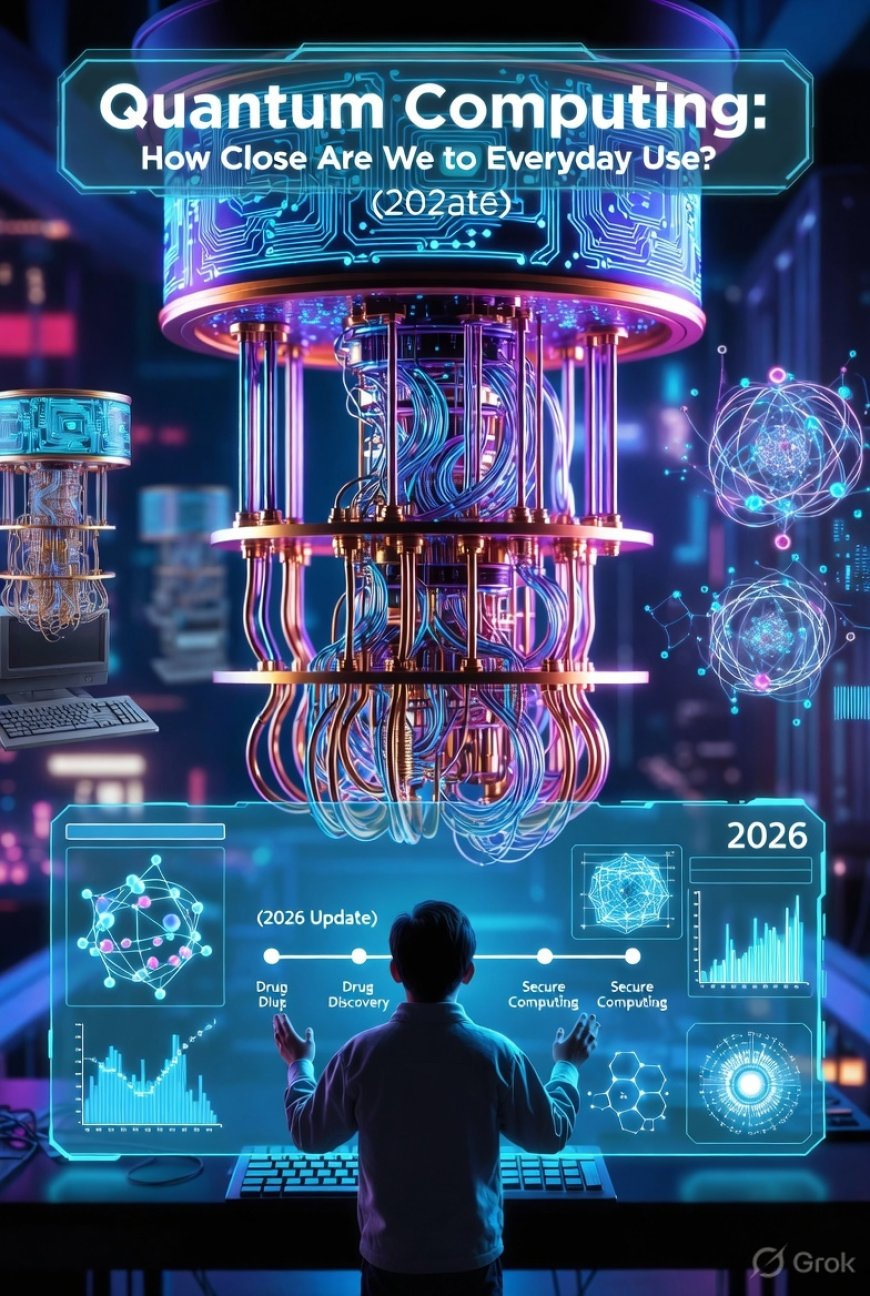
Quantum Computing: How Close Are We to Everyday Use?
Forget the sci-fi hype—2026 marks a pivotal year where quantum computing shifts from lab curiosity to strategic business reality. With fresh U.S. executive orders, billions in investments, and rapid progress in error correction, the question isn't if quantum will matter, but when it reaches everyday impact.
Where We Stand Today
- Hardware Progress: Systems from IBM (Heron processors), Google, IonQ, and Quantinuum now feature hundreds to over 1,000 qubits. Logical qubits and error correction demos are slashing error rates dramatically—moving from noisy intermediate-scale quantum (NISQ) toward practical utility.
- Early Wins: Hybrid quantum-classical setups are already aiding molecular simulations for drug discovery (e.g., Hepatitis D genome modeling), financial portfolio optimization, materials science, and logistics. Companies like Boeing and Vanguard are piloting real value.
- Challenges Remain: Full fault-tolerant systems (needed for broad supremacy) are targeted for 2028–2033. Quantum computers won't replace your laptop—they'll act as specialized accelerators in the cloud for tough problems classical machines can't crack efficiently. No room-temperature consumer devices yet.
Realistic Timeline for Everyday Use
- Now–2027: Cloud access for R&D; "quantum-enhanced" improvements in AI, medicine, and optimization (invisible to most users).
- 2028–2030: Quantum advantage in key industries (pharma, finance, energy). First commercial products in data centers.
- 2030s+: Broader integration—better drugs, secure comms, advanced materials, and personalized tech. True "everyday" indirect benefits via improved services.
Governments and enterprises are "quantum curious" because waiting could mean falling behind, much like with AI. The industry could hit $1+ trillion by 2035.
As of mid-2026, quantum computing has moved decisively from laboratory curiosity to early practical demonstrations, but everyday consumer use (like replacing your laptop or phone) remains years away. This update explores the rapid progress toward "quantum advantage" in specialized fields, the persistent challenges of error correction and scalability, and realistic timelines for broader impact.
Key Highlights (2026 Perspective):
- Current State (NISQ Era): Systems from IBM (1,000+ physical qubits on Condor/Heron), Google (Willow chip demonstrating below-threshold error correction), Quantinuum (up to 48+ logical qubits on Helios with high fidelity), QuEra, IonQ, and others are achieving meaningful results. Hybrid quantum-classical approaches and quantum-inspired algorithms already deliver 10–30% efficiency gains in logistics, optimization, finance, and materials simulation.
- Breakthroughs in Practical Applications:
- Drug discovery & chemistry: Quantum simulation of molecules and proteins (e.g., Cleveland Clinic, Mitsubishi Chemical, IBM partnerships) that classical computers struggle with.
- Optimization & logistics: Real-world pilots in supply chains, routing, and portfolio management showing measurable ROI.
- Materials science & energy: Faster modeling for new catalysts, batteries, and alloys.
- Early "practical quantum advantage" claims, such as 3,000x speedups in specific simulations.
- Fault-Tolerant Progress: Logical qubits (error-corrected) are advancing fast, with demonstrations of hundreds of physical qubits encoding dozens of logical ones. Roadmaps from major players target useful fault-tolerant systems (hundreds of logical qubits) by 2028–2029, enabling reliable, large-scale computations.
- Challenges Remaining: Quantum systems are still noisy, expensive, require extreme conditions (e.g., cryogenic cooling), and excel only at specific problems—not general-purpose tasks. Full everyday integration is likely 10–15+ years out for most applications, though quantum-safe cryptography and hybrid tools are being adopted now.
This piece provides a balanced, hype-free assessment: quantum computing is delivering real value today in research and industry niches, with accelerating momentum toward transformative utility in the late 2020s. Perfect for readers interested in tech trends, investment opportunities, or the future of computing. It includes expert insights, company roadmaps, use cases, and what individuals/organizations should do to prepare.
Quantum isn't about surfing the web on a qubit phone—it's about solving intractable problems that reshape industries and daily life behind the scenes.
What excites (or worries) you most about the quantum era? Drop your thoughts! 🚀 Will we see quantum utility sooner than expected?
What's Your Reaction?
 Like
0
Like
0
 Dislike
0
Dislike
0
 Love
0
Love
0
 Funny
0
Funny
0
 Angry
0
Angry
0
 Sad
0
Sad
0
 Wow
0
Wow
0